
# How Does HownIt Work? A Guide for Buyers and Tenants
Are you looking to buy your next home or find a property to rent?
Finding somewhere new should be exciting, but we know the process can sometimes feel overwhelming, especially if you're a first-time buyer or renting for the first time.
That's why we created HownIt!
Think AutoTrader… but for properties!
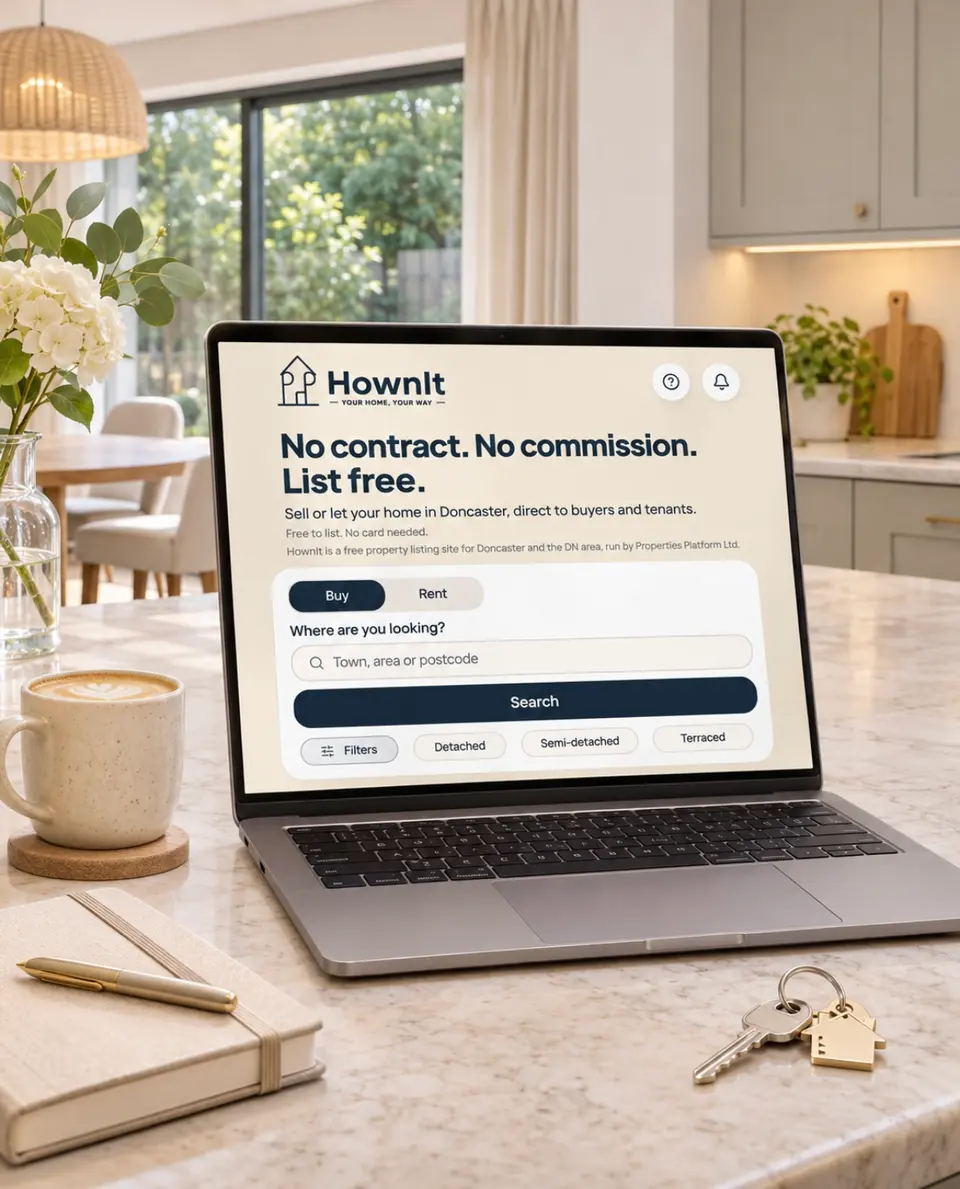
HownIt is a property advertising platform that allows buyers and tenants to discover properties, contact sellers or landlords and arrange their own viewings, all in one place.
Whether you're buying your first home, moving to somewhere bigger or looking for a rental property, HownIt gives you more choice and control over your property search.
Here's how it works and what happens once you've found somewhere you love.
Part 1: Finding a Property on HownIt
Step 1: Visit HownIt and Search for Properties
Head over to www.HownIt.com and select whether you're looking to Buy or Rent.
You can search for properties by town, area or postcode and narrow down your results using filters such as:
- Location
- Price range
- Property type
- Number of bedrooms
- Other property features
We're currently welcoming properties across Doncaster and the surrounding DN postcode areas, with plans to expand further across the UK.
Step 2: Explore Properties and Save Your Favourites
Found a property that catches your eye?
Select the listing to view its photographs, description, asking price or monthly rent, and other important details.
You can also save properties to your Favourites, making it easier to compare different homes and return to the ones you love.
Step 3: Contact the Seller or Landlord Directly
One of the main features of HownIt is our built-in messaging system.
If you're interested in a property, you can send an enquiry directly through the listing.
You might want to ask:
- Is the property still available?
- What is included in the sale or rental?
- Is there a property chain?
- When would the property be available?
- Are there any important details I should know before viewing?
Where a property is being advertised privately, you can communicate directly with the owner or landlord. If an estate agent is advertising the property, they may manage enquiries on their client's behalf.
Step 4: Arrange a Viewing Using Our Interactive Calendar
Found somewhere you would like to see in person?
Select Request a Visit and use HownIt's interactive calendar to propose a date and time that works for you.
The seller or landlord can:
- Accept your requested viewing.
- Decline if they're unavailable.
- Suggest an alternative date or time.
You can then communicate through HownIt's messaging system to confirm any additional details.
It's a simple way to arrange viewings without endless telephone calls or waiting for messages to be passed between people.
Step 5: Attend Your Viewing
When attending a viewing, take your time to look around and ask questions.
If you're buying, consider the property's condition, local area, energy efficiency and any repairs that might be needed.
If you're renting, ask about the monthly rent, deposit, bills, available move-in date and who will manage the property during your tenancy.
Remember, photographs are helpful, but viewing a property in person is an important part of making an informed decision.
Part 2: Buying a Property – What Happens Next?
You've found a home you love and you're ready to take things further. What now?
Step 6: Make an Offer
If you're interested in purchasing the property, you can contact the seller directly through HownIt's messaging system to discuss making an offer.
You and the seller can negotiate a price that works for you both.
Before making an offer, it's sensible to understand your budget, including your mortgage options, deposit and additional buying costs.
If your offer is accepted, the seller can update their HownIt listing to Sold Subject to Contract (Sold STC).
Important: In England and Wales, an accepted offer does not make the sale legally binding. This normally happens when contracts are exchanged.
Step 7: Arrange Your Mortgage or Proof of Funds
Once your offer has been accepted, you'll need to show that you're financially prepared to proceed.
If you're buying with a mortgage:
You should contact your mortgage lender or mortgage adviser to progress your full mortgage application.
The lender will normally review your income, financial commitments, deposit and the property's value before deciding whether to issue a mortgage offer.
If you're a cash buyer:
You will need to demonstrate that you have sufficient funds available to complete the purchase.
The seller may ask for evidence of your ability to proceed, but your solicitor or conveyancer will also need to carry out appropriate checks.
Step 8: Instruct a Solicitor or Conveyancer
This is one of the most important steps when buying a property.
Even when you're buying directly from a private seller through HownIt, you still need an appropriately qualified legal professional to handle the conveyancing process.
Your solicitor or conveyancer will usually:
- Verify your identity.
- Check your source of funds and request supporting evidence.
- Review the property's legal ownership and title.
- Carry out the necessary property searches.
- Review contracts and raise enquiries with the seller's solicitor.
- Liaise with your mortgage lender, where applicable.
- Arrange the exchange of contracts.
- Transfer the purchase money securely at completion.
- Deal with Stamp Duty Land Tax where applicable and register your ownership with HM Land Registry.
What is proof of funds?
This means providing evidence of where the money for your property purchase is coming from.
Depending on your circumstances, your solicitor may ask for bank statements, savings records, evidence of an inheritance, gifted deposit documents or paperwork relating to another property sale.
These checks help meet legal requirements designed to prevent fraud and money laundering.
Step 9: Arrange a Property Survey
Before committing to a purchase, it's strongly recommended that you consider arranging an independent property survey.
A qualified surveyor can assess the property's condition and identify issues that might not be obvious during a viewing.
Depending on the property, you might choose:
- RICS Level 2 Survey: Generally suitable for many conventional properties in reasonable condition.
- RICS Level 3 Survey: A more detailed inspection, often suitable for older, unusual or significantly altered properties.
A survey may identify damp, structural concerns, roofing problems or repairs that need further investigation.
Remember, a mortgage lender's valuation is not the same as an independent property survey.
If the survey highlights unexpected problems, you can discuss them with the seller and obtain professional advice before deciding how to proceed.
Step 10: Exchange Contracts and Complete Your Purchase
Once your mortgage, searches, enquiries and other legal checks are satisfactory, your solicitor or conveyancer will prepare for exchange of contracts.
Exchange of contracts is when the sale becomes legally binding in England and Wales.
Your solicitor will explain the financial commitments, deposit arrangements and agreed completion date.
Completion day is when the remaining purchase money is transferred through the legal representatives, the sale completes and you become the new owner.
You'll then arrange to collect your keys, organise your move and begin settling into your new home!
Once the sale has officially completed, the seller can update their HownIt listing from Sold STC to Sold.
Part 3: Renting a Property – What Happens Next?
If you're looking to rent rather than buy, the process is slightly different.
Here's what you can expect once you've found a property you would like to call home.
Step 6: Express Your Interest
After viewing a rental property, contact the landlord or person managing the listing through HownIt to explain that you're interested in proceeding.
You can discuss the advertised monthly rent, preferred move-in date and any questions about the tenancy.
Under the current rules in England, landlords cannot encourage rental bidding or accept offers above the advertised rent.
Step 7: Complete the Application and Referencing Checks
If the landlord is happy to consider your application, they may ask you to complete referencing and affordability checks.
These can include:
- Proof of identity
- Proof of income or employment
- Employment references
- Previous landlord references
- Credit checks, where appropriate
- Guarantor information, if required
Who carries out these checks?
If the landlord is letting the property privately, they are responsible for arranging the necessary checks themselves or through an appointed referencing provider.
If a letting agent is involved, they may carry out the checks on the landlord's behalf.
Unlike purchasing a property, tenants do not normally need a solicitor for a standard residential tenancy application.
Step 8: Right to Rent Checks
Before a new residential tenancy begins in England, the landlord or their appointed agent must carry out the legally required Right to Rent checks.
These checks confirm that the adults who will occupy the property have the legal right to rent a home in England.
Depending on your circumstances, you may be asked to provide acceptable identity documents or a Home Office share code.
The checks must be carried out correctly and without unlawful discrimination.
HownIt does not replace the landlord's responsibility to complete these checks.
Step 9: Agree the Tenancy and Review Your Documents
Once your application and necessary checks are completed, the landlord can proceed with the tenancy arrangements.
For most new private assured tenancies in England, the Renters' Rights Act changes introduced on 1 May 2026 mean that tenancies are now assured periodic tenancies, which run on a rolling basis rather than having a fixed end date.
Before agreeing to the tenancy, make sure you understand:
- The monthly rent and payment date.
- The tenancy start date.
- The deposit amount.
- Who is responsible for bills and council tax.
- Repair and maintenance arrangements.
- The notice requirements.
- Any other relevant tenancy conditions.
The landlord must also provide the legally required written information about the tenancy.
Step 10: Pay Your Deposit and Arrange Your Move
Depending on the tenancy, you may be asked to pay a refundable holding deposit while your application is being processed.
In England, a holding deposit is generally limited to one week's rent.
A tenancy security deposit is generally limited to five weeks' rent, or six weeks where the annual rent is £50,000 or more.
Where a tenancy deposit is taken for an assured periodic tenancy, the landlord or letting agent must protect it in a government-approved scheme within 30 days and provide the required information.
Under the rules introduced in May 2026, landlords cannot request or accept rent before the tenancy agreement is signed. Once signed, they can request up to one month's rent in advance before the tenancy starts.
Before moving in, make sure you receive the relevant safety and tenancy documentation and agree how and when the keys will be handed over.
It's also a good idea to review the property's inventory, take photographs of its condition and record meter readings.
Once your tenancy begins, you can move in and start making your new home your own.
The landlord can then update the HownIt listing from Let Agreed to Let.
Part 4: Do You Need an Estate Agent When Using HownIt?
Not necessarily!
HownIt allows homeowners and landlords to advertise their properties themselves, meaning buyers and tenants can communicate directly with them.
However, estate agents and letting agents are also welcome to advertise properties through HownIt.
Estate agents provide services such as marketing, conducting viewings, negotiating offers and helping transactions progress. Letting agents may also provide referencing, tenancy administration and ongoing property management.
It's important to understand that estate agents and solicitors do different jobs.
For property purchases, estate agents can carry out identity, financial and anti-money-laundering checks, as required by their legal obligations. However, a solicitor or conveyancer handles the legal transfer of ownership, contract work and conveyancing checks.
Whether you purchase through an estate agent or directly from a private seller, those legal steps remain necessary.
For rentals, landlords are responsible for complying with their legal obligations, whether they handle everything themselves or appoint a letting agent.
HownIt provides the platform for advertising, searching, communicating and arranging viewings. It does not replace solicitors, surveyors, mortgage lenders, referencing providers or the legal duties of landlords and agents.
Part 5: What Does HownIt Cost?
HownIt is completely FREE to advertise on!
- No HownIt advertising fees.
- No HownIt commission.
- No contracts with HownIt.
- No estate agent required to advertise privately.
- Estate agents can advertise their clients' properties for free.
- Buyers and tenants can browse properties, make enquiries and arrange viewings through the platform.
Please remember: Although HownIt does not charge for its advertising service, buying or renting a property can still involve separate costs.
For buyers, these may include mortgage costs, solicitor or conveyancer fees, surveys, searches and applicable taxes.
For tenants, these may include rent and permitted deposits.
Any fees owed under an existing estate agency agreement also remain the responsibility of the relevant parties.
Why Choose HownIt?
We wanted to create a property platform that gives people more choice when it comes to buying, selling and renting.
Whether you prefer to communicate directly with a private seller or landlord, or you're interested in a property advertised by an estate agent, HownIt offers another place to discover properties.
With our direct messaging system, interactive viewing calendar and favourites feature, we aim to make the process of finding your next home as straightforward as possible.
We're a new, family-founded business currently welcoming properties across Doncaster and the DN postcode areas, with plans to expand further across the UK.
Ready to Find Your Next Home?
Whether you're a first-time buyer, moving home or searching for your next rental property, start exploring what's available on HownIt today!
Visit www.HownIt.com and begin your property search.
Your home, Your way – HownIt.
---
References
- GOV.UK (2019). How to Buy a Home. Guidance on buying property, mortgages, conveyancing, identity checks, making offers and completing a purchase.
https://www.gov.uk/government/publications/how-to-buy-a-home/how-to-buy
- Royal Institution of Chartered Surveyors (RICS). House Surveys: The Costs, Types and Benefits of an RICS Home Survey. Guidance on property surveys and choosing the appropriate level of inspection.
https://www.rics.org/consumer-guides/house-surveys-uk-the-costs-types-and-benefits-of-an-rics-home-survey
- GOV.UK (2026). Renters' Rights Act Overview for Tenants. Information on changes to private renting in England, including assured periodic tenancies and tenants' rights.
https://www.gov.uk/guidance/renters-rights-act-overview-for-tenants
- GOV.UK (2026). Renters' Rights Act: An Overview for Landlords. Guidance on landlords' responsibilities and the changes introduced on 1 May 2026.
https://www.gov.uk/guidance/renters-rights-act-an-overview-for-landlords
- GOV.UK (2026). Fees You Can Charge as Part of a Tenancy. Information on permitted rental payments, holding deposits and tenancy deposit limits.
https://www.gov.uk/guidance/fees-you-can-charge-as-part-of-a-tenancy
- GOV.UK. Tenancy Deposit Protection. Guidance on protecting tenants' deposits through government-approved schemes.
https://www.gov.uk/tenancy-deposit-protection
- GOV.UK. Checking Your Tenant's Right to Rent. Guidance on identity documents, immigration status and the checks landlords or appointed agents must complete.
https://www.gov.uk/check-tenant-right-to-rent-documents
- GOV.UK (2026). Tenancy Agreements: Written Information for Your Tenant. Guidance on the written tenancy information landlords must provide under the current rules in England.
https://www.gov.uk/guidance/tenancy-agreements-written-information-for-your-tenant
- GOV.UK (2026). Asking for Rent in Advance: Guidance for Local Authorities. Information explaining restrictions on requesting rent before a tenancy begins.
https://www.gov.uk/government/publications/asking-for-rent-in-advance-guidance-for-local-authorities/asking-for-rent-in-advance-guidance-for-local-authorities
- HownIt. Property Advertising Platform. Information about HownIt's property search, advertising and communication services.
https://www.hownit.com
---
Information in this article is intended as general guidance for buying and renting property in England. Property laws and regulations may change, and individual circumstances can vary. Readers should consult the latest government guidance and seek independent legal, financial or professional advice where appropriate.
References accessed: 15 November 2026.